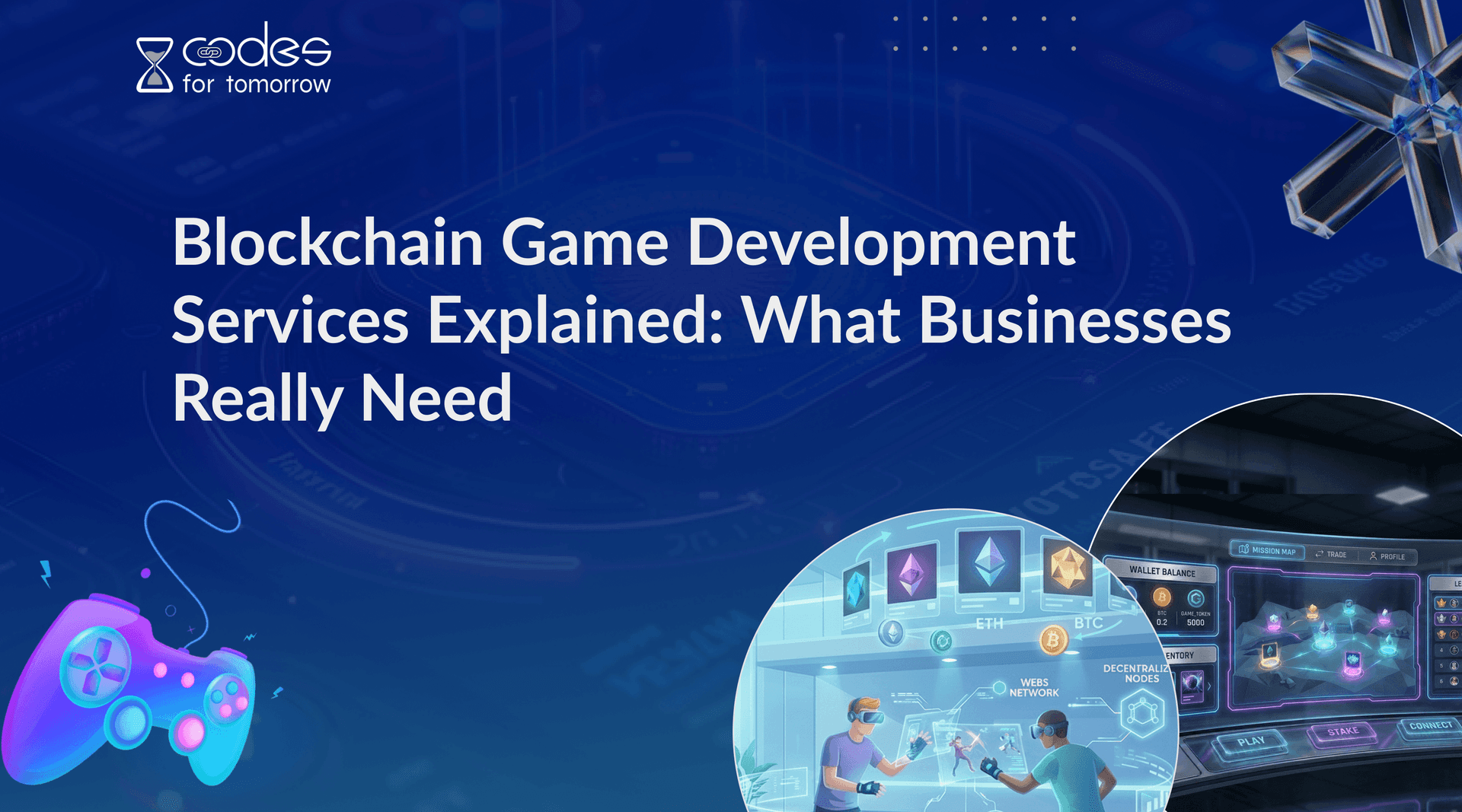
Blockchain Game Development Services Explained: What Businesses Really Need
CF
Author
Codes For Tomorrow
Codes For Tomorrow is a team of protocol engineers building Layer 1 networks, on-chain protocols and MPC wallets for enterprises.
BlockchainGameDevelopmentWeb3Gaming
The gaming industry is continuously changing, with blockchain right at the leading edge of this change in how digital experiences are created, played, and monetized. Traditional models cater to gamers' needs for entertaining gameplay but fail to provide true ownership, transparency, and decentralized control. Blockchain has stepped in, allowing a new wave of innovation to give players true ownership of assets while earning and being a part of decentralized gaming economies.
Understanding blockchain game development services will be important for startups, enterprises, and gaming studios alike in building the next generation of web-3 gaming experiences. Whether you plan an NFT-based game, a play-to-earn platform, or a metaverse project, choosing the right blockchain game development company can make all the difference.
This blog explains what blockchain game development comprises, why businesses need it, and how to choose the right partner from among top blockchain game development companies.
What are Blockchain Game Development Services?
Blockchain game development services refer to a full suite of technical and creative solutions aimed at the development of digital games that are decentralized, transparent, and value-driven. The service integrates blockchain architecture, game mechanics, tokenomics, NFTs, smart contracts, wallets, and web3 integrations into immersive next-generation gaming ecosystems.
A reliable Web3 game development company covers all aspects, from the conceptualization of your plans to deployment, ensuring that your game leverages blockchain technology to the fullest.
Key Components of Blockchain Game Development
1. Smart Contract Development
Smart contracts are the backbone of any blockchain game, serving to automate game rules, manage asset ownership, distribute rewards, and ensure transparent gameplay.
A professional blockchain game development company will write, test, and audit your smart contracts for maximum security.
2. NFT Development & Integration
NFTs are allowing players to truly own in-game assets such as characters, skins, weapons, virtual land, or collectibles.
This ownership model increases engagement for players and opens up new revenue streams.
The best P2E and GameFi experiences require well-designed token economies.
Services usually include:
Utility token creation
Governance token development
Reward mechanisms
Anti-inflationary policies
Player-driven economic models
An experienced web-3 game development company ensures that the economy of your game is long-term and sustainable.
4. Custom Game Development
Blockchain gaming can be developed in 2D, 3D, or VR, depending on one's vision.
This includes:
Gameplay mechanics
Creating Storyline
UI/UX design
Multiplayer support
Marketplace integration
Whether it be creating games of AAA quality or lightweight web-3 mini games, strong blockchain game development services cover end-to-end game creation.
5. Wallet Integration
Players need wallets to store crypto tokens, NFTs, and rewards from in-game activities.
Secure wallet onboarding ensures that:
Smooth user experience
Safe transactions
Simplified asset management
One of the top companies for blockchain game development supports integrations with MetaMask, Coinbase Wallet, WalletConnect, and custom in-game wallets.
6. Marketplace Development
NFT marketplaces allow players to buy, sell, and trade assets freely.
This adds real economic value to your game and positively affects player retention.
Most blockchain game development companies offer:
Marketplace UI/UX
Auction & bidding systems
Royalty automation
Asset verification
7. Metaverse Integration
Many companies are experimenting with virtual worlds driven by blockchains.
Services related to Metaverse include:
Creating avatars
Tokenization of virtual land
Social features
Real-time multiplayer environments
Integration of VR & AR
Why Businesses Need Blockchain Game Development
1. True Asset Ownership
Traditional games store assets on a central server.
With blockchain, ownership could be verified, meaning that players have complete control over their in-game collectibles through the use of NFTs.
2. Improved Transparency
Game rules, reward distributions, and transactions become verifiable on-chain.
This helps build trust among the players and makes your platform more reliable.
3. New Revenue Streams
Blockchain brings multiple monetization models.
NFT sales
Token launches
Commissions charged by marketplaces
Play-to-earn reward systems
Businesses working with a web 3 game development company are able to unlock scalable and sustainable revenue opportunities.
4. Global Player Base
Blockchain gaming attracts worldwide communities for whom innovation, earnings, and decentralized experiences are critical.
5. Cross-Platform Flexibility
Most blockchain-based games are cross-compatible on:
Mobile
Web
Desktop
VR devices
This expands your reach and user engagement.
6. Future-Proof Technology
Investing in blockchain gaming positions your brand at the forefront of digital innovation for this decade.
Various types of Blockchain Games Businesses can create
Play to Earn Games
Players receive crypto tokens or NFTs while playing.
Very popular for community and long-term retention.
Move-to-Earn Games
The players are rewarded based on their real-world physical activities.
NFT-Based Games
The in-game assets are NFTs that the players can trade or own.
Metaverse Games
Large virtual worlds based on land ownership, social interaction, and immersive environments.
Strategy & RPG Blockchain Games
Ideal for advanced gameplay, tokenized assets, and multi-layer mechanics.
A good blockchain game development company will be able to help you select the best model based on your goals.
How to Choose the Best Blockchain Game Development Company
Delivering a secure, scalable, and engaging web-3 game requires finding the right partner.
Here's what you should look for:
1. Portfolio & Experience
Review past web-3 or blockchain game projects to ensure expertise.
2. Supported Blockchain Platforms
Companies should collaborate with:
Ethereum
BNB Chain
Polygon
Solana
Avalanche
3. Smart Contract Security
Ask about auditing, vulnerability testing, and compliance.
4. Knowledge of Tokenomics
A capable web-3 game development company should offer strong economic planning.
5. Creative Game Design
Blockchain is the backend; the game still has to be FUN.
6. Timelines & Budget Transparency
Estimates of the cost should be transparent, as well as milestones.
7. Post-Launch Support
Look for companies offering:
Maintenance
Feature enhancements
Bug fixes
Security patches
Advantages of Working with Professional Blockchain Game Development Companies
With a well-established service provider,
you will have:
Faster time-to-market
Reduced development risks
Secure smart contracts
High-quality gameplay mechanics
Better scalability
Future upgrades and support
Good blockchain game development companies help to avoid costly mistakes and ensure the best performance of your game.
Conclusion
Blockchain is transforming the gaming industry, opening up new possibilities for players, creators, and businesses alike. Whether it's a play-to-earn ecosystem, an NFT-based game, or an immersive metaverse experience, having the right blockchain game development company as your partner makes all the difference.
Comprehensive blockchain game development services, including smart contracts, NFTs, tokenomics, wallet integration, marketplace development, and web-3 infrastructure, enable businesses to create innovative, secure, and rewarding game worlds.
As the blockchain continues to develop, companies investing in it now will be the leading ones in the future of web-3 gaming. Choose wisely, plan strategically, and work with expert blockchain game development companies to bring your vision to life.
Frequently Asked Questions (FAQs)
Ans- They include end-to-end solutions such as smart contracts, NFT creation, tokenomics, wallet integration, marketplaces, game design, and Web3 infrastructure to build decentralized games.
Ans- Blockchain games offer real asset ownership, transparent transactions, new revenue models like NFTs and tokens, global player reach, and long-term scalability.
Ans- NFTs give players true ownership of in-game assets, allow open trading, and add value to gameplay through scarcity, collectibility, and revenue opportunities.